100 Flight Aviation Icons Set, Isometric: A Practical Evaluation for Modern Design Projects
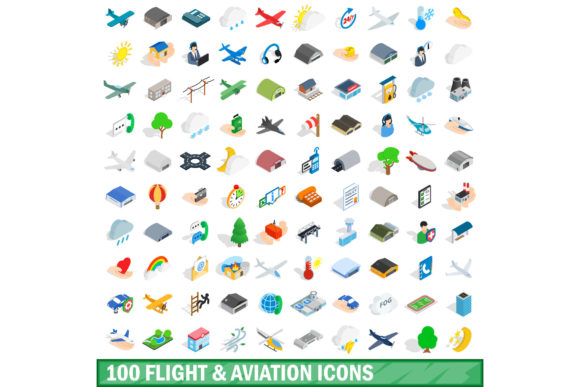
In the competitive landscape of digital design, finding assets that balance technical accuracy with aesthetic appeal is often a challenge. The 100 Flight Aviation Icons Set, Isometric addresses this specific need by offering a comprehensive collection of 3D-style vector illustrations tailored for aviation and travel themes. Unlike flat iconography which can sometimes feel two-dimensional or generic, this set leverages isometric projection to create depth, scale, and a sense of realism without sacrificing the clean lines required for modern UI/UX design.
For professionals ranging from freelance graphic designers to marketing agencies specializing in travel tech, the utility of an asset library extends far beyond mere decoration. It serves as a foundational element in conveying complex information quickly. This evaluation explores the characteristics, usability, and practical applications of the 100 Flight Aviation Icons Set, Isometric, analyzing how it fits into various professional workflows and project requirements.
Understanding the Isometric Advantage in Aviation Design
The choice of isometric style for aviation icons is not merely a trend; it is a functional decision rooted in clarity. Isometric drawings maintain parallel lines and consistent scaling, allowing viewers to perceive three dimensions on a two-dimensional surface. When applied to aircraft, airports, and travel logistics, this perspective offers a distinct advantage: it reveals structural details—such as wings, engines, landing gear, and terminal layouts—that are often lost in silhouette or flat styles.
The 100 Flight Aviation Icons Set, Isometric capitalizes on this by providing a cohesive visual language. Whether you are designing a dashboard for a flight tracking application, a brochure for an airline, or a presentation deck for an aerospace startup, consistency is paramount. Mixing different artistic styles can disrupt the user experience and dilute brand identity. By utilizing a unified set like this, designers ensure that every element, from a small airplane icon to a large luggage cart illustration, shares the same lighting, shadow, and geometric logic.
Key Characteristics and Technical Specifications
A critical factor in the adoption of any digital asset is its technical flexibility. The 100 Flight Aviation Icons Set, Isometric stands out due to its multi-format availability, including JPG, EPS, AI, PSD, and PNG. This variety caters to diverse software environments and output needs.
- Vector Formats (EPS, AI): These files are essential for scalability. For print media such as posters, banners, or high-resolution brochures, vector graphics ensure that the images remain crisp regardless of size. Designers can manipulate individual paths, adjust colors to match brand guidelines, and modify shapes without losing quality.
- Raster Formats (JPG, PNG): While vectors offer infinite scaling, raster files are often necessary for web deployment where file size optimization is crucial. The inclusion of PNGs with transparent backgrounds allows for seamless integration over various website backgrounds or mobile app interfaces.
- Layered Files (PSD): For users working in Adobe Photoshop, the layered structure provides granular control. Elements can be isolated, recolored, or combined with other photographic elements to create composite images.
The sheer volume of 100 icons ensures coverage across the entire aviation ecosystem. This includes commercial aircraft, private jets, helicopters, drones, airport infrastructure like terminals and control towers, ground support equipment, and travel-related items such as passports, boarding passes, and luggage. The comprehensiveness reduces the need for designers to source disparate assets from multiple vendors, streamlining the creative process.
Practical Applications and Real-World Use Cases
The versatility of this icon set makes it suitable for a wide array of industries. In the realm of User Interface (UI) design, the isometric style is particularly effective for dashboards and infographics. For example, a travel aggregator app might use these icons to visualize flight status, baggage handling, or gate locations. The 3D effect adds a layer of engagement that encourages users to interact with the data.
Marketing materials also benefit significantly from this resource. Small business owners and entrepreneurs in the tourism sector often struggle to produce high-quality visuals on a budget. High-end photography of aircraft can be prohibitively expensive and legally restricted. The 100 Flight Aviation Icons Set, Isometric offers a cost-effective alternative that maintains a premium look. Agencies can create compelling ad campaigns, social media posts, and email newsletters using these assets, ensuring the content looks polished and professional.
Educators and publishers find value in the set's ability to simplify complex concepts. When explaining air traffic control procedures, airport security protocols, or aerodynamics, isometric illustrations provide a clear visual aid that is easier to digest than text-heavy explanations. Bloggers covering aviation news can enhance their articles with relevant imagery that breaks up long blocks of text and improves reader retention.
Evaluating Quality, Consistency, and Usability
Quality assessment of icon sets often hinges on consistency. In many collections, artists may change styles midway through, resulting in a disjointed final product. Based on the specifications of the 100 Flight Aviation Icons Set, Isometric, the focus appears to be on maintaining a uniform aesthetic throughout the entire library. The isometric angles, shadow intensity, and color palettes are designed to work together harmoniously.
However, usability depends heavily on the organization of the files. Professional workflows require assets that are easy to locate and modify. The availability of editable vector formats suggests that the set is intended for active manipulation rather than static display. Users should expect to be able to recolor icons to align with specific corporate identities. For instance, an airline with a blue and white livery can easily adapt the grey-scale or default colored icons to fit their branding without needing to recreate them from scratch.
Reliability is another key metric. In a professional setting, broken links or corrupted files are unacceptable. The provision of standard industry formats implies a level of stability and compatibility with major design software suites like Adobe Illustrator, Photoshop, and Affinity Designer. This ensures that the investment in the asset yields long-term value, as the files will remain usable even as software versions evolve.
Who Benefits Most from This Resource?
While the potential applications are broad, certain groups will derive the most immediate value from the 100 Flight Aviation Icons Set, Isometric.
- Freelance Graphic Designers: Those who take on diverse projects often face tight deadlines. Having a ready-made library of high-quality aviation icons allows them to deliver polished work quickly without spending hours modeling 3D objects themselves.
- Startups and Entrepreneurs: Founders in the travel-tech space need to establish credibility instantly. Custom 3D assets can elevate a prototype from looking like a concept to appearing like a finished product, which is crucial for attracting investors and early adopters.
- Content Creators and Publishers: Bloggers and YouTubers focusing on aviation need engaging visuals to compete in a saturated market. This set provides the visual hooks necessary to capture audience attention.
- Corporate Marketing Teams: Large organizations requiring internal presentations or external communications about logistics and transport can utilize these icons to maintain a consistent corporate image across all channels.
Potential Limitations and Considerations
To provide a balanced view, it is important to acknowledge potential limitations. While the set is extensive, it may not cover every niche scenario within the aviation industry. Highly specialized military aircraft or obscure regional models might not be included. Additionally, while the isometric style is popular, it may not suit every design philosophy. Brands seeking a minimalist, ultra-flat, or hand-drawn aesthetic might find the 3D rendering too heavy or detailed for their specific needs.
Furthermore, the effectiveness of the icons relies on proper implementation. Simply dropping an image onto a webpage does not guarantee success. Designers must consider contrast, sizing, and context. If the icons are used at a very small size on a mobile interface, the intricate details of the isometric style might become indistinct. In such cases, relying on the simpler outlines or simplified versions (if available) would be more appropriate.
Final Thoughts on Long-Term Value
The 100 Flight Aviation Icons Set, Isometric represents a significant resource for anyone involved in aviation-themed design. Its strength lies in the combination of visual depth, technical versatility, and comprehensive coverage. By offering multiple file formats, it accommodates both print and digital workflows, making it a robust tool for professionals who demand reliability and quality.
For creators looking to enhance their visual storytelling without compromising on production time, this set offers a practical solution. It bridges the gap between the need for realistic representation and the constraints of modern design efficiency. Whether used for a high-stakes pitch deck, a consumer-facing app, or educational material, the consistent isometric style provides a professional polish that elevates the overall quality of the final output. As the aviation industry continues to grow and digitize, having access to high-quality, scalable assets remains a strategic advantage, and this collection delivers precisely that.