Evaluating the 100 Navigation Icons Set for Modern Web and App Design
In the complex landscape of digital interface design, the choice of visual assets often determines the usability and aesthetic appeal of a final product. Among the vast array of resources available to designers, the 100 Navigation Icons Set stands out as a comprehensive collection designed to streamline the creation of user interfaces. This set is not merely a bundle of images; it represents a structured approach to navigation, offering clarity and consistency across various platforms. However, selecting the right asset requires more than just counting the number of icons provided. It involves understanding the specific stylistic nuances, technical formats, and versatility that these graphics bring to a project.
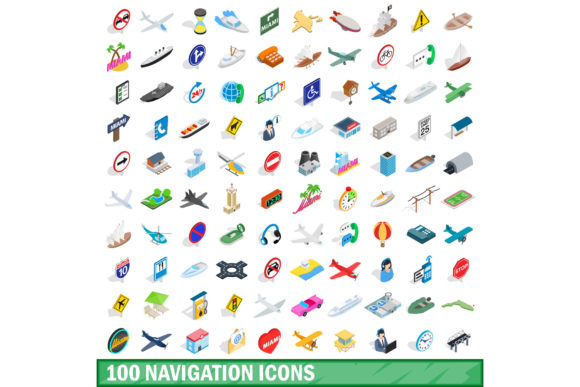
When researchers or professional designers evaluate this collection, they are often looking for a balance between quantity and quality. The core value proposition lies in the inclusion of both standard 2D representations and a specialized 100 navigation icons set in isometric 3d style. This duality allows for a broader application range, catering to flat design trends while also accommodating the growing demand for depth and dimensionality in modern UI/UX patterns. By providing such variety within a single package, the set addresses a common pain point: the need to maintain a cohesive visual language without switching between disparate libraries.
Distinguishing Features of the Collection
The primary distinction of this icon set is its commitment to format flexibility. In professional workflows, the ability to edit vectors is paramount. The inclusion of AI (Adobe Illustrator) and EPS files ensures that designers can scale, recolor, and modify individual elements without losing resolution. This is particularly critical when adapting a navigation bar for different screen sizes, from mobile devices to large desktop monitors. Furthermore, the availability of PSD (Photoshop Document) files offers those who prefer raster-based editing a robust foundation, complete with layers and smart objects that facilitate non-destructive editing.
While many collections focus solely on one style, this set bridges the gap between traditional flat aesthetics and isometric perspectives. The isometric 3D variation is not simply a filter applied to existing icons; it is a distinct design interpretation that adds depth. This is crucial for applications requiring a sense of realism or spatial awareness, such as dashboards, gaming interfaces, or complex data visualization tools. Conversely, the standard 2D icons provide the necessary neutrality for minimalist designs where distraction must be minimized. Having both styles under one roof allows teams to experiment with different visual hierarchies without compromising brand consistency.
Comparing Format Capabilities and Workflow Integration
A significant factor in evaluating any design resource is how well it integrates into existing software ecosystems. The JPG and PNG formats included in this set cater to quick deployment scenarios. PNG files, with their support for transparency, are ideal for web overlays and mobile app interfaces where background blending is essential. JPGs, while less versatile for transparency, offer smaller file sizes suitable for contexts where compression is prioritized over perfect edge rendering. However, for true scalability, the vector formats remain the gold standard.
When compared to generic icon packs found on free stock sites, the advantage of this set lies in its organized structure. Generic sets often suffer from inconsistent stroke widths, mismatched corner radii, or varying levels of detail. The 100 navigation icons set in isometric 3d style, by contrast, maintains a uniform geometric logic throughout the entire collection. This consistency reduces the cognitive load on the designer, who does not have to spend hours aligning paths or adjusting anchor points to make disparate icons look like they belong together. For agencies managing multiple client projects, this efficiency translates directly into reduced production time and higher deliverable quality.
It is also worth noting the compatibility of these formats with modern development tools. While the source files are native to Adobe Creative Cloud, the export capabilities allow for seamless conversion into SVG or CSS sprites, which are the preferred formats for responsive web development. The presence of high-resolution PNGs ensures that the icons remain crisp on Retina displays and other high-density screens, a requirement that cannot be overlooked in contemporary mobile-first design strategies.
Assessing Strengths and Potential Tradeoffs
The strength of the 100 Navigation Icons Set is undeniably its versatility. Whether a team is building a corporate website, a fintech application, or an e-commerce platform, the sheer volume of options covers almost every navigational need. From basic "home" and "settings" buttons to more complex actions like "drag," "expand," or "filter," the set provides a comprehensive vocabulary for user interaction. The isometric 3D style adds a layer of sophistication that can elevate a design from functional to engaging, making it particularly attractive for startups aiming to differentiate their visual identity.
However, there are tradeoffs to consider. The richness of the isometric 3D style may not suit every brand. Brands that adhere strictly to minimalism or Swiss design principles might find the 3D elements too heavy or distracting. In such cases, relying solely on the 2D portion of the set is necessary, which means the investment in the full 100-icon bundle might feel slightly disproportionate if the 3D elements are unused. Additionally, the learning curve for modifying isometric assets can be steeper than working with simple vector shapes. Designers unfamiliar with isometric grids may require additional time to understand the perspective rules before they can effectively edit the 3D icons.
Another consideration is the file size. High-quality vector files, especially those containing complex isometric details, can result in larger download sizes compared to simplified icon packs. For teams with strict bandwidth constraints or older legacy systems, this could be a minor hurdle, though it is rarely a dealbreaker in modern development environments. The decision ultimately hinges on whether the visual payoff justifies the initial processing overhead.
Determining the Best Fit for Your Project
Deciding whether to adopt this specific set depends heavily on the project's scope and the target audience. If you are designing a SaaS platform that requires a clean, professional look but needs to avoid appearing sterile, the combination of flat and isometric icons offers a perfect middle ground. The ability to switch between styles allows for dynamic interactions, such as using 3D icons for active states and 2D icons for inactive ones, creating a subtle yet effective feedback loop for users.
For educational purposes or internal tooling, the EPS and AI formats are invaluable. They empower designers to create custom variations that fit specific branding guidelines without needing to hire a graphic artist for every minor adjustment. This autonomy is a key benefit for small teams or freelancers who need to maintain agility. On the other hand, if the project is a simple blog or a static brochure site, the extensive library might be overkill. In such scenarios, a smaller, more focused pack of flat icons might suffice, saving budget and storage space.
Furthermore, the set is highly relevant for cross-platform design initiatives. With the proliferation of tablets, foldables, and smartwatches, maintaining a consistent navigation experience across devices is challenging. The scalable nature of the vector files ensures that the same icon can serve a watch face and a desktop dashboard without pixelation or distortion. The isometric 3D style, in particular, works well on touchscreens where depth cues can enhance the tactile feel of the interface.
Alternatives and Final Considerations
While the 100 navigation icons set in isometric 3d style offers a compelling solution, it is not the only option on the market. Open-source communities provide thousands of free alternatives, often in SVG format. These are excellent for hobbyists or low-budget projects. However, they often lack the curated consistency and professional polish of a dedicated commercial set. Free resources may require significant manual cleanup to ensure all icons share the same line weight and style. In contrast, this set guarantees a unified aesthetic from the first use.
There are also premium competitors that specialize exclusively in 3D or exclusively in flat design. If a project demands a hyper-specific 3D aesthetic, such as a game UI, a specialized 3D asset store might offer more granular control. Yet, for general-purpose navigation, the hybrid approach of this set provides superior cost-efficiency. It eliminates the need to purchase two separate licenses to achieve a mixed-media design.
Ultimately, the choice comes down to the specific requirements of the design system. If the goal is to build a robust, scalable, and visually rich interface that can adapt to various contexts, the 100 Navigation Icons Set presents a strong case. Its diverse format support, ranging from editable vectors to ready-to-use rasters, combined with the unique addition of isometric 3D styles, makes it a versatile tool for serious designers. By weighing the benefits of consistency and variety against the potential complexity of the 3D elements, stakeholders can make an informed decision that aligns with their long-term design goals.
As digital products continue to evolve, the demand for high-quality, adaptable visual assets will only increase. Investing in a resource that balances quantity with stylistic diversity, such as this set, positions teams to handle future design challenges with greater confidence and creativity.