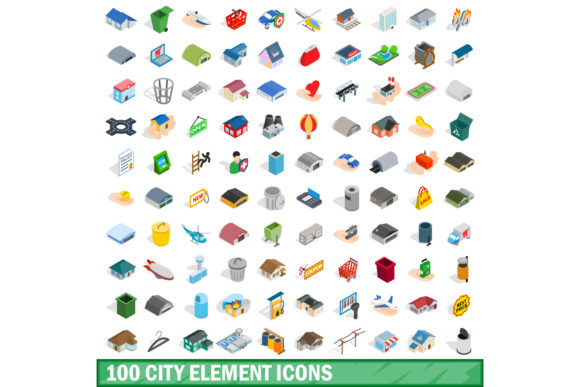
100 City Element Icons Set, Isometric 3d
Urban design is more than just concrete and steel; it is a visual language that tells stories about how we live, work, and move. When you need to translate the complexity of a metropolis into a clean, engaging graphic, the 100 City Element Icons Set, Isometric 3d offers a sophisticated solution. This collection moves beyond flat, two-dimensional symbols to provide depth, perspective, and a tactile quality that modern interfaces crave. Whether you are building a mobile app for navigation, creating an infographic for a real estate report, or designing a presentation for a city planning committee, these vector illustrations provide the structural backbone for your narrative.
The isometric style is particularly powerful because it eliminates the distortion of perspective while maintaining a sense of three-dimensionality. Unlike standard 3D rendering, which can be heavy and require complex lighting setups, isometric graphics remain crisp at any scale. They allow designers to pack information densely without cluttering the visual field. By utilizing this specific set, creators gain access to a curated library of urban components that feel cohesive yet versatile enough to adapt to various branding guidelines.
Why Isometric Graphics Dominate Modern Design
In an era where users scan content rapidly, static icons often fail to capture attention. The 100 City Element Icons Set, Isometric 3d solves this by introducing volume and shadow in a controlled manner. This style bridges the gap between technical diagrams and artistic illustration. It feels grounded and realistic, yet stylized enough to fit into playful or corporate environments alike.
For professionals working on user experience (UX) projects, these icons serve a dual purpose: they are aesthetically pleasing and functionally clear. A bus stop icon in isometric 3D immediately communicates "transportation" with greater clarity than a flat circle with a dot inside. The added depth guides the eye naturally, helping users process information faster. This is crucial for dashboards, maps, and instructional materials where cognitive load must be minimized.
- Depth without Distortion: The fixed angle ensures that all elements maintain consistent proportions, making them perfect for architectural layouts and floor plans.
- Scalability: Being available in vector formats like EPS and AI, these icons can be resized from a tiny favicon to a massive billboard without losing resolution.
- Cohesion: Since every element shares the same light source and perspective, mixing different icons results in a unified look rather than a disjointed collage.
Practical Applications Across Industries
The versatility of this asset extends far beyond simple decoration. Different sectors can leverage the 100 City Element Icons Set, Isometric 3d to solve specific communication challenges. For marketers and entrepreneurs, these visuals are goldmines for storytelling. Imagine launching a new co-working space; using isometric icons of desks, coffee cups, and meeting rooms can instantly convey the atmosphere of the venue better than a paragraph of text.
For educators and bloggers, the set provides a way to visualize abstract concepts related to urban living, sustainability, or infrastructure. Creating a blog post about green cities becomes significantly more engaging when readers can see stylized trees integrated with buildings in a 3D context. Similarly, small business owners can use these graphics to create custom menus, service brochures, or social media posts that stand out in a crowded digital feed.
Freelancers and publishers will appreciate the efficiency this set brings to their workflow. Instead of spending hours modeling each building or streetlamp individually, they can assemble scenes quickly. The inclusion of multiple file formats—JPG, PNG, PSD, AI, and EPS—means that whether you are editing layers in Photoshop or drawing paths in Illustrator, the assets integrate seamlessly into your existing pipeline.
Customization and Creative Adaptation
One of the most compelling aspects of this set is its adaptability. While the icons come pre-rendered in a specific style, the vector nature of the files allows for deep customization. If your brand identity relies on a specific color palette, you can easily recolor the elements within Adobe Illustrator or Inkscape. The shadows and highlights can be adjusted to match the lighting direction of your other graphics, ensuring a professional finish.
Designers can also deconstruct the icons to create entirely new compositions. You might take a single skyscraper from the set and combine it with a park element to visualize a "green city" concept. Or, you could isolate a traffic sign and enlarge it to serve as a bold background texture for a poster. The possibilities are limited only by your imagination and your ability to arrange the elements logically.
- Color Strategy: Experiment with monochromatic schemes for a sleek, high-tech look, or use vibrant gradients to evoke energy and excitement.
- Layering: Use the transparency options in PSD files to layer icons over photographs or textured backgrounds, creating a mixed-media effect.
- Animation Potential: The 3D structure makes these icons ideal for motion graphics. Rotating a building or panning across a cityscape adds a dynamic layer to web headers or video intros.
Maintaining Consistency and Clarity
While creativity is essential, effective design requires discipline. When integrating the 100 City Element Icons Set, Isometric 3d into a project, consistency is key. Avoid mixing isometric elements with flat icons or photorealistic images unless you have a very specific stylistic reason to do so. Mixing styles can confuse the viewer and undermine the professional quality of the output.
To keep your results organized and audience-friendly, establish a grid system before you begin placing elements. Because isometric graphics rely on precise angles, aligning objects to a 30-degree grid ensures that the final composition looks intentional rather than accidental. Furthermore, consider the context of your audience. For a technical manual, prioritize clarity and legibility over decorative flair. For a marketing campaign, you might push the colors and lighting to create emotional resonance.
Remember that less is often more. A well-composed scene with five carefully chosen icons is more impactful than a cluttered image filled with fifty elements. Use the set to highlight the most important features of your subject matter. If you are illustrating a transportation hub, focus on the trains, platforms, and signage. Leave out extraneous details that do not contribute to the core message.
Technical Advantages for Professionals
From a technical standpoint, the availability of the set in both raster and vector formats is a significant advantage. The JPG and PNG files offer immediate usability for quick mockups or web usage where editing capabilities are not required. Meanwhile, the EPS, AI, and PSD files empower advanced users to manipulate the geometry, extract individual parts, or apply complex filters.
This flexibility supports a wide range of workflows. A developer might need a PNG sprite sheet for a website, while a print designer needs the vector EPS file for a high-resolution brochure. Having all these formats in one package streamlines the handoff process between team members and reduces the time spent converting files. It ensures that the vision remains intact from the initial sketch to the final production.
Ultimately, the 100 City Element Icons Set, Isometric 3d is more than just a bundle of graphics; it is a toolkit for visualizing the built environment. It empowers creators to communicate complex urban ideas with simplicity and style. Whether you are defining a new brand identity, explaining a logistical plan, or simply adding a touch of modern aesthetics to your next project, these icons provide the reliable foundation you need to succeed. By focusing on clarity, consistency, and creative adaptation, you can transform standard data into compelling visual narratives that resonate with your audience.